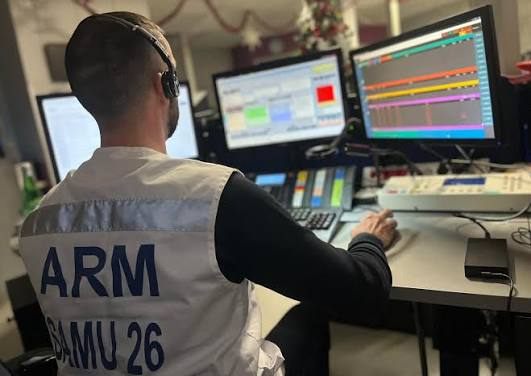
A Minute Gained: What Time Really Means in Medical Regulation
Time in medical regulation: a tangible reality
In medical regulation, a minute gained is never abstract.
It is not a theoretical unit, nor a performance indicator. It is an operational reality, immediately perceptible to the teams.
After more than a year working alongside regulation centers, we have observed that time translates into very concrete effects:
- It is a call answered slightly earlier.
- A voice heard without haste.
- A situation assessed with greater perspective.
In practice, time is not measured only in seconds. It is measured in available attention. That attention determines the quality of listening and, ultimately, the accuracy of the medical decision.
Medical regulation and caregivers’ cognitive load
Each call requires intense concentration. Careful listening. The ability to decide quickly, often under pressure.
In medical regulation centers, this cognitive load is constant.
What we observe in the field is that when time becomes scarce, it is not only the pace that accelerates. The quality of the assessment becomes harder to maintain. Not because of a lack of competence, but because of a lack of mental availability.
In this context, gaining time does not mean going faster. It means preserving caregivers’ ability to analyze, prioritize, and decide accurately, even when pressure is at its peak.
Call saturation and constant tension in regulation centers
The daily reality of regulation centers is marked by continuous tension. Calls follow one another. Situations unfold in succession. There are few genuine moments of pause.
This call saturation demands constant vigilance. The difference between hesitation and decision can sometimes be a matter of seconds. Between doubt and proper referral, there is often only a brief additional moment of listening.
It is this reality made up of continuous flows and chained decisions that shapes the work of medical regulation teams.
What time truly enables in medical regulation
In public debate, time is often discussed in terms of delays, statistics, or congestion. More rarely is it addressed in terms of what it truly makes possible.
On the ground, time makes it possible to:
- Listen without haste,
- Understand a situation that is still unclear,
- Prioritize effectively,
- Make a well-informed medical decision.
This is precisely where much of the effectiveness of medical regulation lies. Not in raw speed, but in the quality of attention given to each call.
Helping caregivers regain meaningful time
At e-sensia, our role is grounded in this logic: helping caregivers recover that precious time where pressure is greatest.
The objective is not to accelerate medicine, nor to standardize it. It is to make it more sustainable, by enabling teams to have the necessary attention at the very moment it is most needed.
“Our challenge is not to save time in order to go faster, but to ensure that caregivers have the right time, at the right moment, to make accurate decisions,” explains Cédric Thoma, co-founder of e-sensia.
Voice intelligence acts here as a safety net for humans: discreet support designed to strengthen listening capacity and secure decision-making, without ever replacing medical judgment.
Gaining a minute to decide better
In emergency situations, gaining a minute does not simply mean moving faster. It often means deciding better.
And in some cases, that minute can make all the difference.
It is this conviction, forged through close contact with the field, that guides e-sensia’s approach: technology designed to support caregivers, preserve what matters most, and strengthen medical regulation where it is under the greatest pressure.