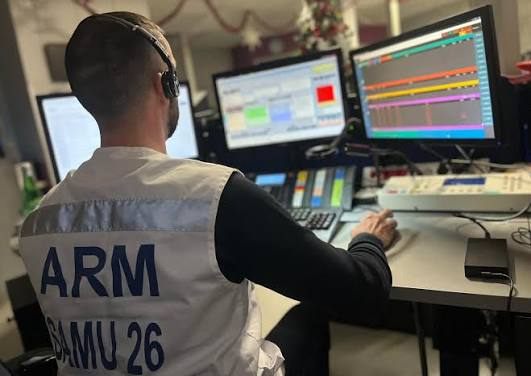
At the FNEHAD Winter University, Dr. Jean-Baptiste Perney, co-founder of e-sensia, spoke to share his experience using voice AI in emergency call regulation.
His speech was part of a broader discussion on the role of artificial intelligence in healthcare, with a particular focus on a central element of emergency care: listening.
Voice as a Medical Signal
In medical regulation, the analysis is not only based on the words spoken, but also on how they are spoken.
Breathing, intonation, vocal effort, and even pauses are among the signals that healthcare professionals learn to interpret with experience.
This clinical intuition, built through listening, is a cornerstone of medical reasoning in emergency situations. The challenge, therefore, is not just to process verbal content, but to analyze the sound and manner of speaking, which are key elements in assessing the severity and urgency of a situation.
Regulating means deciding quickly and accurately
The regulation of emergency calls, whether it concerns SAMU or SOS Médecins, aims to answer these central questions: Is it serious? Is it urgent? What care should be directed to the caller?
In this context, every minute counts. The objective is to:
Answer calls as quickly as possible,
Help detect high-risk situations,
Direct each call to the most appropriate response.
The voice AI developed by e-sensia aligns with this logic, serving as a support for human decision-making by providing a safety net capable of alerting when danger signals are perceptible in the voice.
Data, Ethics, and Trust
The issues related to health data were also discussed.
Data quality, ethics, control, and sovereignty are inseparable from the conditions for adopting artificial intelligence in healthcare. Trust is a fundamental prerequisite, both for professionals and patients.
Producing traceable data, with controlled origins and uses, is essential for evaluating practices and sustainably improving medical regulation.
Better Understanding the Outcome for Patients
Finally, a widely shared limitation was highlighted: after an emergency call, it is often difficult to know the outcome for the patients.
However, this information is crucial for assessing the relevance of directions taken and improving practices.
In this regard, the importance of evaluation approaches and clinical studies was emphasized, in order to analyze the concrete effects of regulation, always under human control and in compliance with regulatory frameworks.